Hazardous Materials Chronology
GBE > Encyclopaedia > Code > Chronology >G#42633
AI Search
Using google search
Q: Is there a schedule of dates that hazardous materials were introduced then withdrawn from construction?
A: It is not possible to create a single, comprehensive schedule of dates for all hazardous materials used and withdrawn from construction.
The history of each substance is different, with varying timelines for introduction, recognition of hazards, regulation, and eventual withdrawal. Factors such as the specific material, country, and time period all affect its use and regulation.
Asking for Google’s AI further search to expand on the first answer
Thinking
Kicking off 5 searches
Looking at 79 sites
Putting it all together
Here is a timeline for some of the most prominent hazardous materials in UK construction.
Asbestos
- Late 1870s: Asbestos begins to be commercially used in the UK, primarily for insulation in ships and power plants. Its properties as a durable, fire-resistant, and cheap material led to widespread use.
- Early 1900s: Health concerns about asbestos emerge, and the first official reports of associated health risks are noted.
- 1930s: Research links asbestos exposure to lung fibrosis, which leads to the first asbestos industry regulations in 1931.
- 1955: A report published in the British Medical Journal demonstrates a link between asbestos exposure and lung cancer.
- 1985: The most hazardous types of asbestos, blue (crocidolite) and brown (amosite), are banned in the UK.
- 1999: A full ban on the import and use of all types of asbestos, including white (chrysotile), is enacted in the UK.
Lead paint
- Pre-1960s: Lead-based paint, particularly white lead, is in widespread use for decorative paintwork in homes.
- 1963: After a voluntary agreement, manufacturers begin labeling paint containing more than 1% lead with warnings.
- 1970s: The amount of lead used in decorative paints is reduced, and non-lead pigments become more common.
- 1992: A full ban on the sale and use of paint containing lead carbonate and lead sulfate is implemented in the UK, though exemptions remain for historic buildings.
Formaldehyde
- Post-WWII: Urea formaldehyde (UF) foam, which can emit formaldehyde gas as it degrades, is used for cavity wall insulation.
- 1985: Building Regulations begin imposing controls on the use of UF foam in cavity walls, requiring a continuous barrier to minimize fumes.
- 1987: The Control of Substances Hazardous to Health (COSHH) Regulations establish occupational exposure limits for formaldehyde.
- August 2026 (EU): A new EU restriction will limit formaldehyde emissions in furniture and wood-based products.
- UK (future): The Health and Safety Executive is investigating risks to the public from formaldehyde and may introduce similar UK legislation.
Polychlorinated Biphenyls (PCBs)
- 1930s–1970s: PCBs are used in construction for a variety of applications, including sealants, paint, and thermal insulation.
- 1981: The UK bans the manufacture and new use of PCBs.
- 1986: As part of an international agreement, the UK joins the wider ban on the production of PCBs.
- 2000s onwards: Phased removal of PCB-containing materials from buildings continues as older structures are refurbished or demolished.
AI responses may include mistakes. For legal advice, consult a professional. Learn more
© GBE GBC GRC GIC GGC GBL NGS ASWSBrian Murphy aka BrianSpecMan ******
20th October 2025
Images:
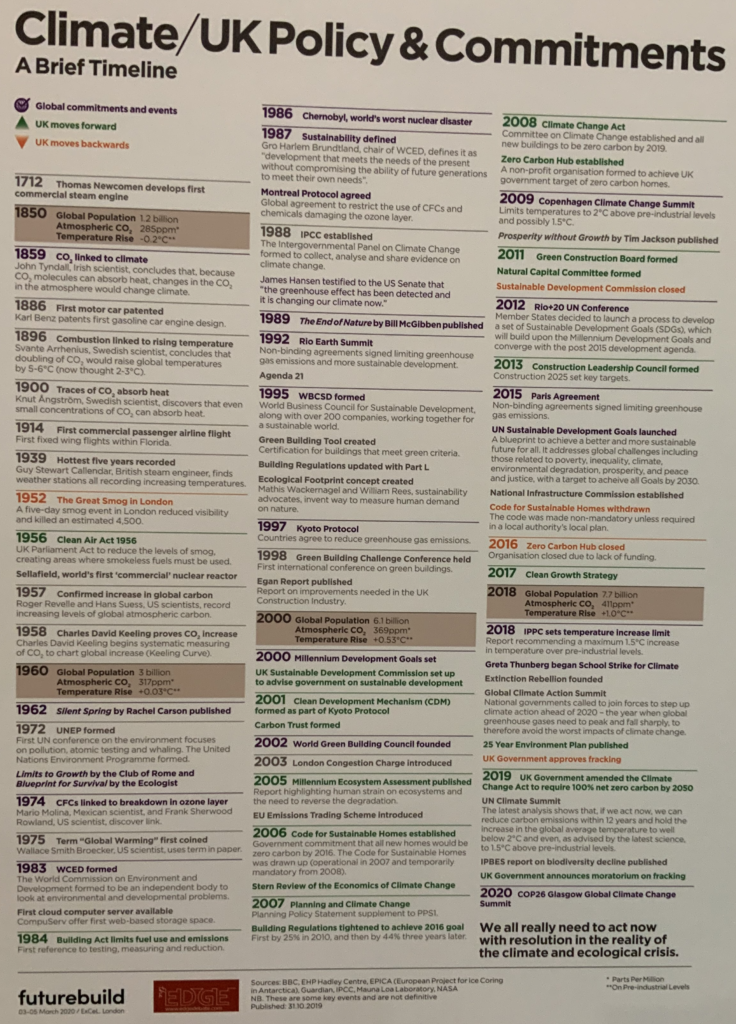
FutureBuild2020 Chronology

© GBE GBC GRC GIC GGC GBL NGS ASWSBrian Murphy aka BrianSpecMan ******
20th October 2025 – 1st June 2026
See Also:
GBE Chronology
- Industrial Revolution to 1999 (Chronology) G#961
- 2000 to date (Chronology) G#1019 N#1038
- Hazardous Materials (Chronology) G#42633 (this page)
GBE Jargon Buster
- Chronology
- Green Chronology
GBE CPD
- Green Chronology
- Green is the Colour
Brian Murphy BSc Dip Arch (Hons & Dist) (Part-time NLP)
- Specification Consultant (37 years)
- ASWS
- Architectural Specification Writing Services.
Part 1
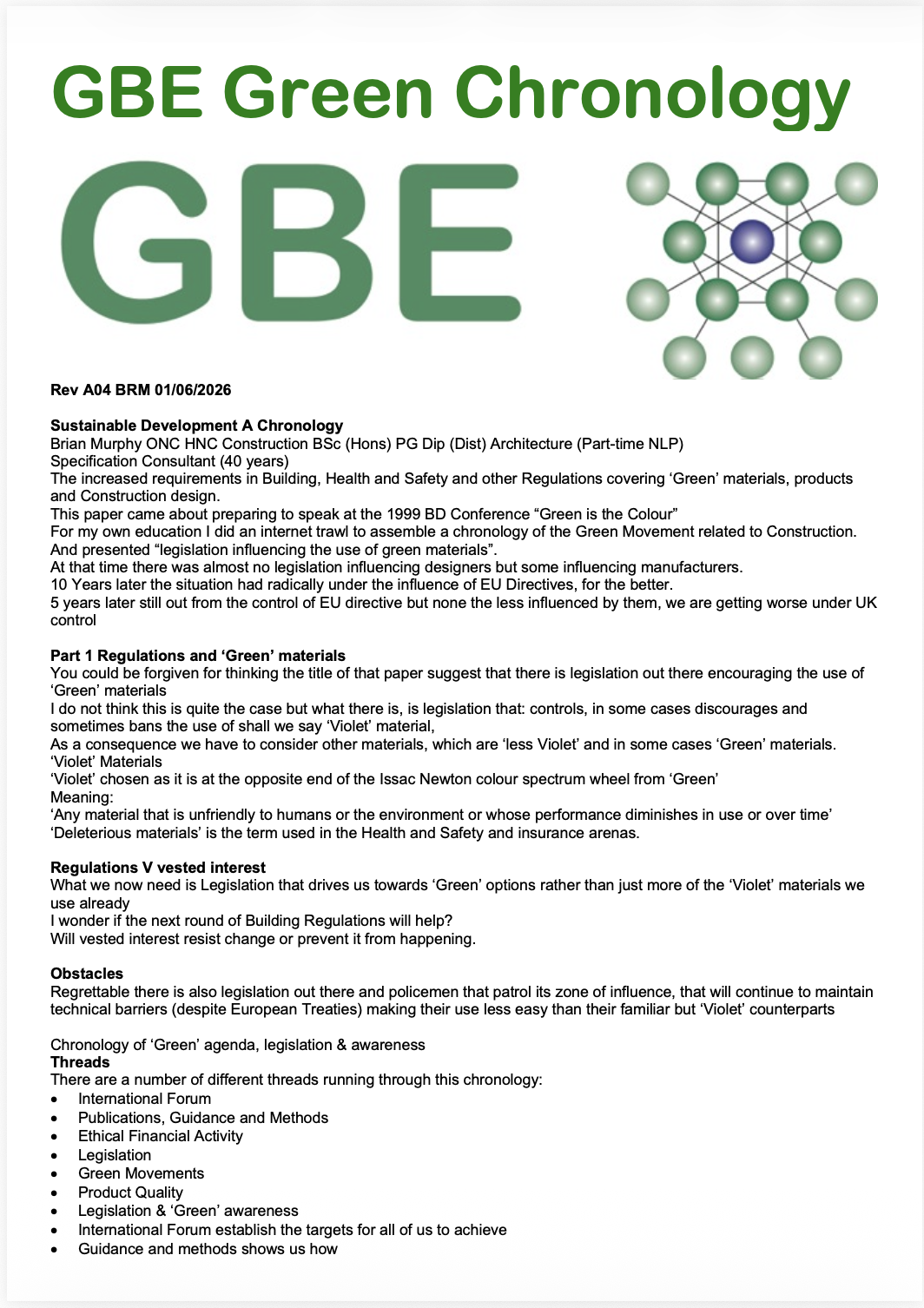
- The increased requirements in Building, Health and Safety and other Regulations covering ‘Green’ materials and products in design.
Part 1 Regulations and ‘Green’ materials
- You could be forgiven for thinking the title of the paper suggest that there is legislation out there encouraging the use of ‘Green’ materials
- I do not think this is quite the case
- but what there is is legislation that:
- controls, in some cases discourages and sometimes bans the use of
- shall we say ‘Violet’ material,
- As a consequence we are having to consider other materials
- which are ‘less Violet’
- and in some cases ‘Green’ materials.
‘Violet’ Materials
- ‘Violet’ chosen as it is at the opposite end of the spectrum from ‘Green’
- meaning:
- ‘any material that is unfriendly to humans or the environment
- or whose performance diminishes in use or over time’
Regulations V vested interest
- What we now need is Legislation that drives us towards ‘Green’ options
- rather than just more of the ‘Violet’ materials we use already
- I wonder if the next round of Building Regulations will help?
- will vested interest resist change or prevent it from happening.
Obstacles
- Regrettable there is also legislation out there
- and policemen that patrol its zone of influence,
- that will continue to maintain technical barriers (despite European Treaties)
- making their use less easy than their familiar but ‘Violet’ counterparts
Threads:
- There are a number of different threads running through this chronology:
- International Forum
- Publications, Guidance and Methods
- Ethical Financial Activity
- Legislation
- Green Movements
- Product Quality
- Legislation & ‘Green’ awareness
- International Forum establish the targets for all of us to achieve
- Guidance and methods shows us how
- Ethical Finance shows us all by example
- Legislation is implemented by governments when the populous fails to respond
- Green movements start when governments fail to act in a responsible manner
GBE Sources
I acknowledge: the following for the idea and some of the content of this Chronology.
- AJ Architects Journal
- BBA British Board of Agrément
- BBC British Broadcasting Corporation
- EHP Hadley Centre
- Estates Gazette 10 Jan 98 Environmental Liability The Muck Stops Here By Tim Smithers and Nic Seal.
- European Project for the ice Coring in Antarctica (EPICA)
- Friends Provident’s Literature “Stewardship Ethical Investment, Acting on your Principles”
- Future Build 2020 Poster 31/10/2019
- Guardian Newspaper
- Mauna Loa Laboratory
- NASA
- numerous other bibliography
© GBE GBC GRC GIC GGC GBL NGS ASWSBrian Murphy aka BrianSpecMan ******
20th October 2025